If you have been paying attention to pH-friendly eating, you have probably found yourself asking: is sprouted whole-grain bread alkaline? The short answer is — it is closer to alkaline than almost any other bread you will find.
But the longer answer is more interesting, and understanding it will change how you think about bread altogether.
What Does Alkaline Actually Mean for Food?
Before getting into the bread, it helps to understand what alkaline means in a food context. The pH scale runs from 0 to 14. Anything below 7 is acidic, 7 is neutral, and anything above 7 is alkaline. Most breads — white bread, whole wheat, even many multigrain varieties — sit on the acidic side of that scale, somewhere between pH 5.0 and 6.5.
The reason comes down to processing. Refined flours, added sugars, and the byproducts of yeast fermentation all push bread toward acidity. The more processed the bread, the more acidic it tends to be.
Sprouted whole-grain bread sits in a different category. Depending on the grains used, it registers around pH 7.0 to 7.5 — neutral to mildly alkaline. That is a meaningful difference, and the sprouting process is entirely responsible for it.
Why Sprouting Changes Everything
When a grain is dry and dormant, it contains phytic acid — a compound that binds to key minerals like calcium, magnesium, potassium, and zinc and prevents your body from absorbing them. You can eat a slice of regular whole wheat bread and genuinely not absorb much of the nutrition listed on the label because phytic acid has locked most of it away.
Research from the Weston A. Price Foundation suggests that up to 80% of the iron and magnesium in unsprouted whole grains may be unavailable for absorption.
Sprouting changes this entirely. When grains are soaked in water and allowed to germinate, enzymes activate that break down phytic acid. Those locked minerals are released and become bioavailable.
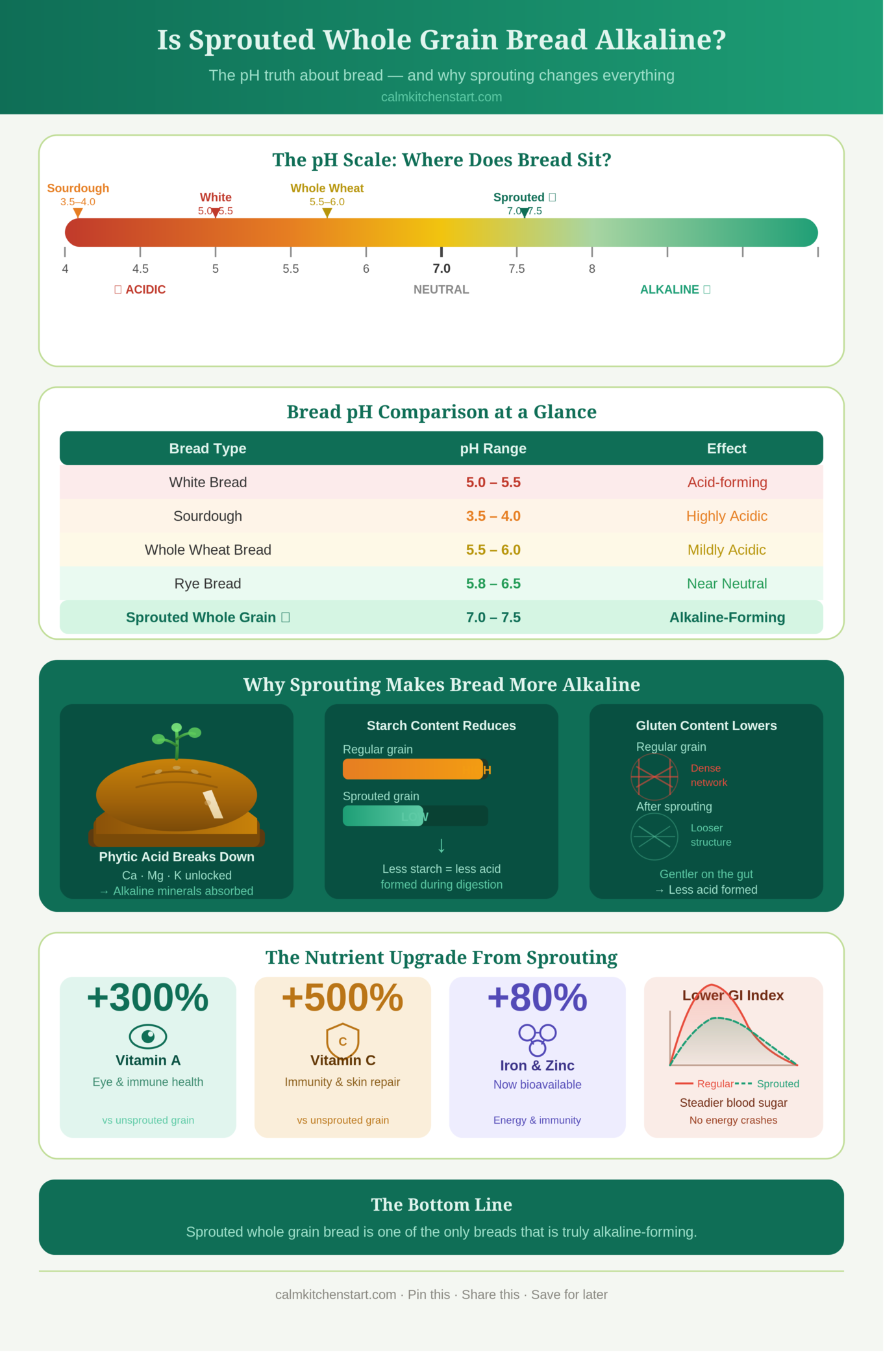
Because calcium, magnesium, and potassium are the body’s chief alkaline minerals, their absorption directly raises the alkaline effect of the bread in your system.
There is also a starch reduction effect worth noting. Germination converts complex starches into simpler sugars to feed the growing sprout. This means sprouted bread has lower starch content than regular bread. Since starch converts to acid during digestion, less starch means a more alkaline outcome overall.
Is Sprouted Whole Grain Bread Alkaline Enough to Make a Difference?
This is the right question to ask. A food’s pH on its own does not tell the whole story — what matters is its ash residue, or what it leaves behind in the body after digestion. This is what the alkaline diet framework is actually built on.
Sprouted whole grain bread leaves behind more alkaline minerals than it does acid-forming residue. Combined with the reduction in phytic acid, the lower starch content, and the reduced gluten load, the net effect on your body’s pH environment is meaningfully positive compared to conventional bread.
That said, it is worth being clear: no single food dramatically shifts your blood pH. Your body maintains blood pH within a very tight range regardless of what you eat.
What an alkaline-leaning diet does is reduce the acid load your kidneys and other systems have to process, which over time can support better bone density, reduced inflammation, and improved energy. Sprouted whole-grain bread sits firmly on the right side of that equation.
The Nutrient Upgrade That Comes With It
Beyond the alkalinity question, sprouted whole-grain bread is simply more nutritious than regular bread — by a considerable margin. The sprouting process increases vitamin A content by up to 300% and vitamin C by up to 500%. Folate, zinc, selenium, and B vitamins are significantly more bioavailable than in unsprouted versions.
The protein in sprouted grains is also partially broken down into amino acids during germination, making it easier for the body to use. And the fibre content, while similar in volume to regular whole grain bread, is more effective because it comes without the anti-nutrient interference of phytic acid blocking mineral absorption alongside it.
For anyone dealing with blood sugar sensitivity, the lower glycaemic index of sprouted bread is another advantage. The conversion of starch during sprouting means it digests more slowly, producing a steadier energy release rather than a sharp blood sugar spike.
What to Look for When Buying Sprouted Whole Grain Bread
Not every loaf labelled sprouted is created equal. Here is what to check before buying.
The first ingredient should be sprouted whole grain — not enriched flour or whole wheat flour with sprouted grain further down the list. That ordering matters.
The ingredient list should be short. Quality sprouted bread requires grains, water, and salt. Long lists with added sugars, preservatives, or dough conditioners reduce the alkaline benefit significantly.
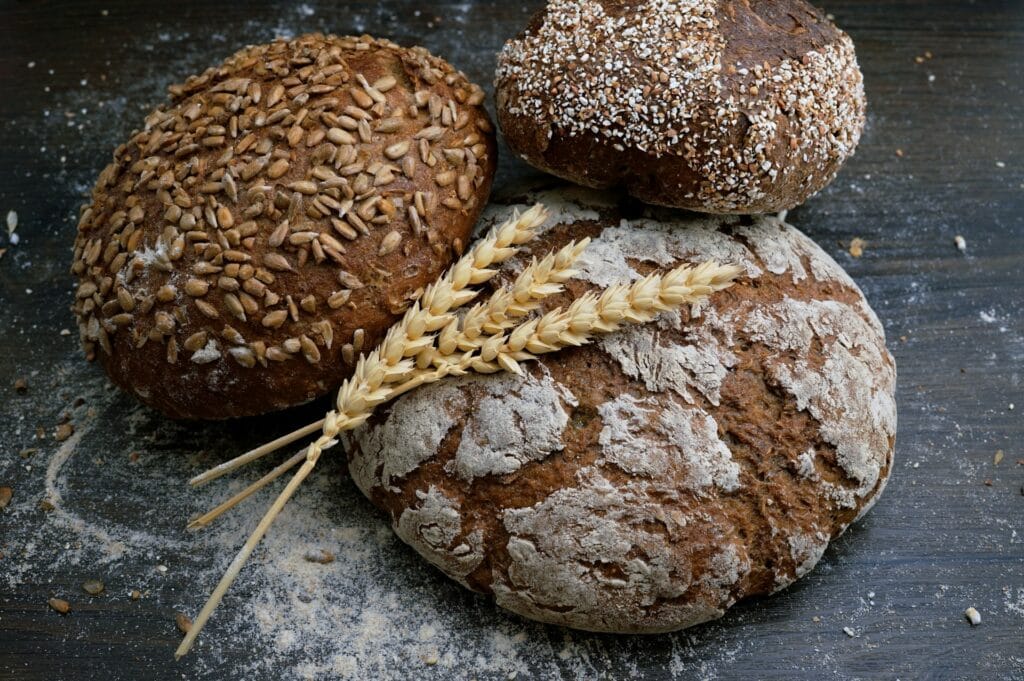
Look for varieties that combine multiple sprouted grains — wheat,rye, millet, lentils, and spelt provide a broader amino acid profile and a more diverse mineral content than single-grain sprouted breads.
Is Sprouted Whole Grain Bread Alkaline Enough for a Full Alkaline Diet?
If you are following a structured alkaline diet, sprouted whole-grain bread is one of the very few bread options that fit comfortably within it. Paired with alkaline-leaning foods — leafy greens, avocado, cucumber, lemon water, almonds — it works with your dietary goals rather than against them.
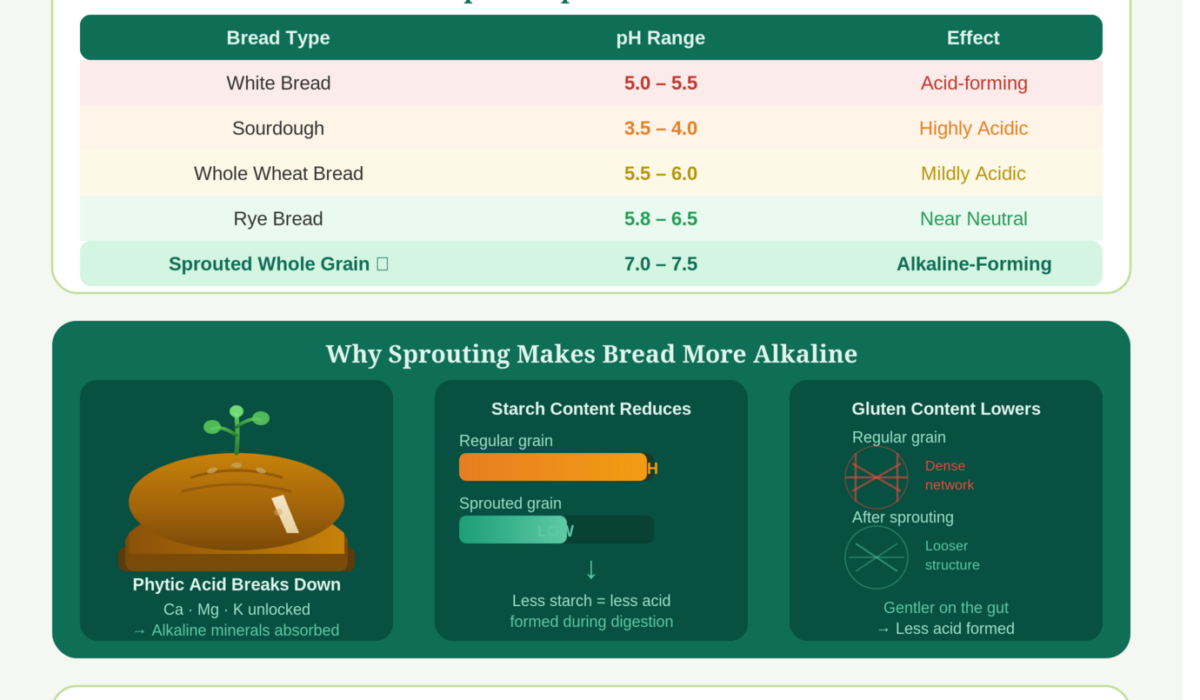
Compare it to the alternatives: white bread sits at pH 5.0–5.5, conventional whole wheat at around 5.5–6.0, and even sourdough — often praised for digestibility — still sits on the acidic side at around pH 3.5–4.0 due to the fermentation acids it contains.
Sprouted whole-grain bread at pH 7.0–7.5 is genuinely in a different category.
Final Thoughts
So, is sprouted whole-grain bread alkaline? Yes — and more importantly, it is alkaline-forming in the body, which is the distinction that actually matters. The sprouting process unlocks minerals, reduces phytic acid, lowers starch content, and decreases gluten — all of which shift the bread from acid-forming to alkaline-supporting.
For anyone trying to eat more intentionally without giving up bread entirely, sprouted whole-grain bread is one of the most straightforward upgrades available. It does not require a dramatic lifestyle change — just a different loaf.